Welcome to WordPress. This is your first post. Edit or delete it, then start writing!
Author: shehan
-

Skool vs Thinkific: Honest Comparison After $5M in Sales
Thinkific has been the go-to for online courses for years.
But now, Skool is quickly gaining popularity, raising the question:
Is it time to leave Thinkific behind?
After using both platforms to make $5M+ in course sales, I’m here to give my honest opinion.
And in this post, I share my thoughts on the question: which platform comes out on top in the Skool vs. Thinkific battle?
What Is Thinkific?
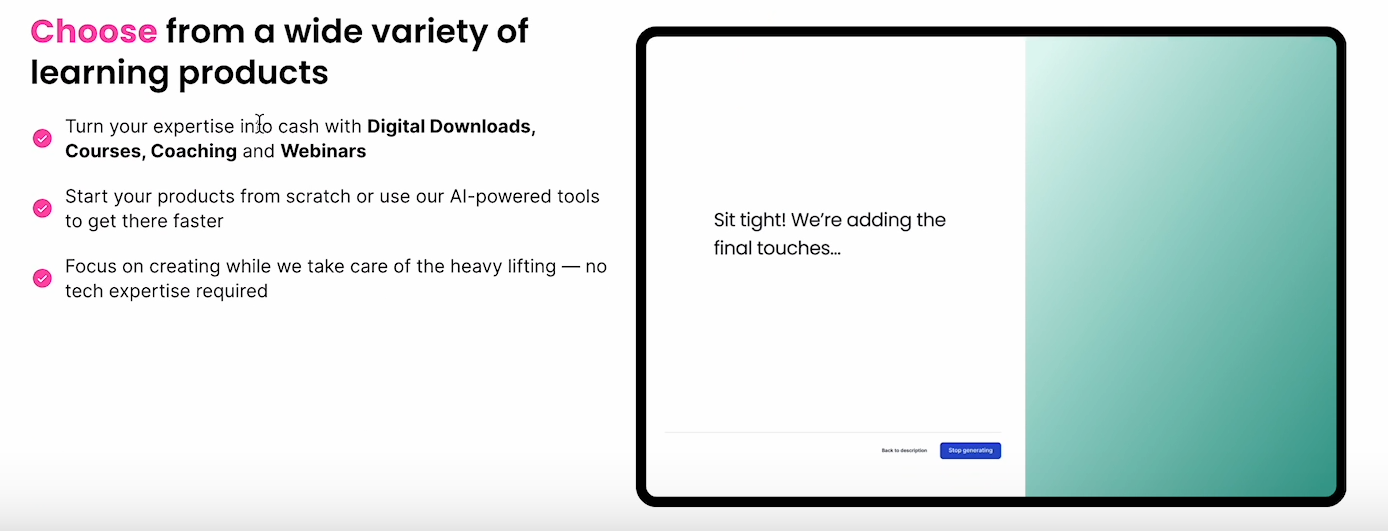
Thinkific is an all-in-one platform.

It’s been designed to help creators build, market, and sell online courses and digital products.
Whether you’re an individual expert or a large organization, Thinkific streamlines knowledge sharing.
Who is Thinkific for?
I believe educators, entrepreneurs, and organizations of different sizes can profit from it.
The platform can work if the entity wants to create and monetize online learning experiences.
Core Features
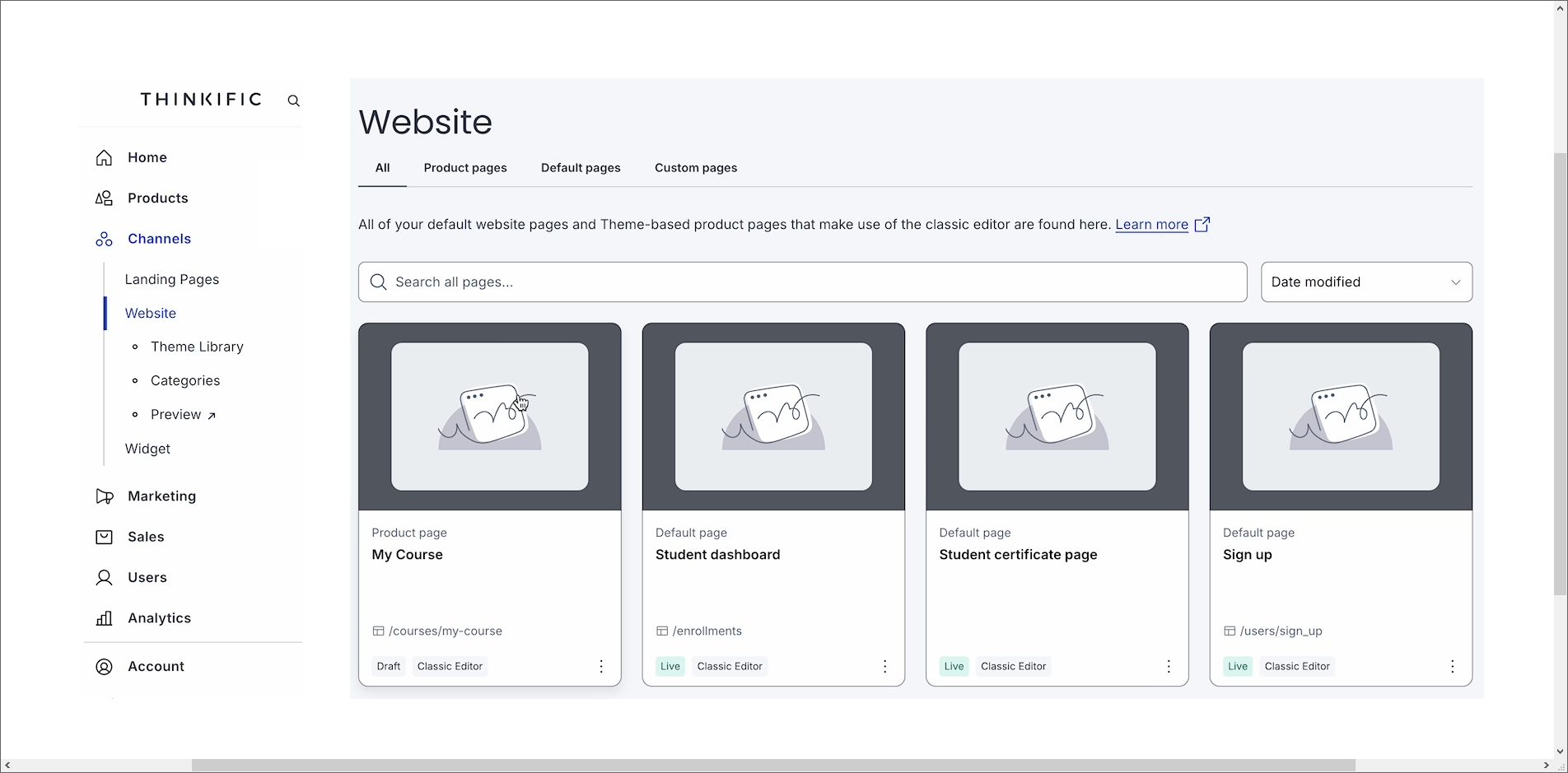
Thinkific has features that simplify everything from creating a course to marketing it.
These include:
- Tools to create online courses from scratch
- A website and landing page builder
- Community management features
- The ability to host live events
- Support for creating a mobile app
- Options for digital downloads
- Marketing and sales tools to grow your business
User Interface and Experience
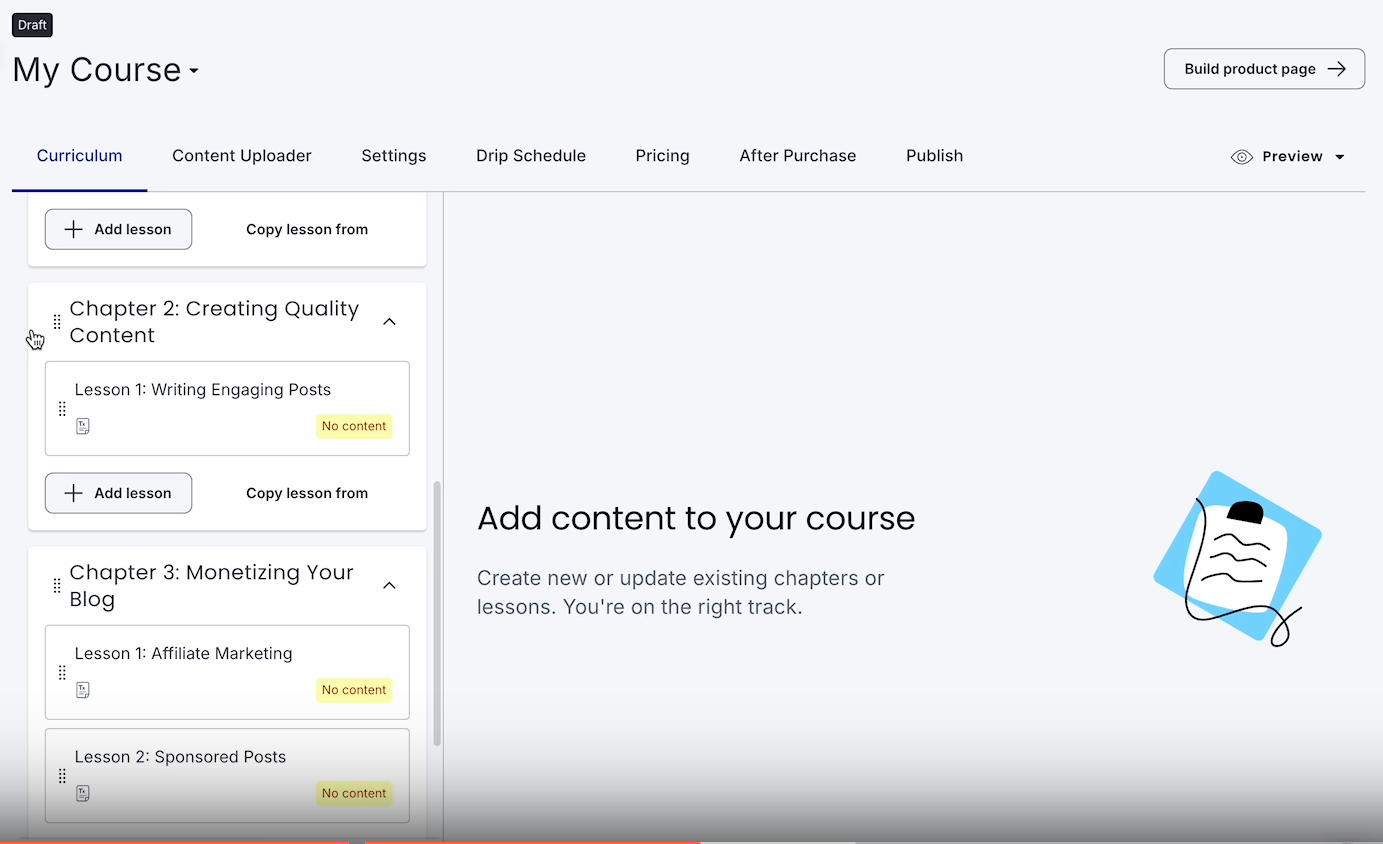
Thinkific prides itself on having a user-friendly interface.
This interface caters to creators with all levels of technical expertise.
Whether you’re new to this or have years of experience, the platform offers a step-by-step process for your online business setup.
The intuitive course builder, AI-powered content creation tools, and drag-and-drop website builder help ensure a smooth experience.
Plus, the mobile-responsive design means your content looks great, no matter the device.
In short, the learning curve is gentle enough for beginners.
At the same time, there’s plenty of depth for more advanced users.
Feature Set and Capabilities
Most people think Thinkific is just about course creation.
It’s not.
It provides a robust set of tools that let you build and sell a variety of digital learning products:
- Community Building: Features like discussion forums, member profiles, activity feeds, and a mobile app make it easy to engage your community.
- Live Events and Coaching: You can host webinars, offer one-on-one coaching, or even provide group coaching sessions.
- Digital Downloads: Set up downloadable products that easily tie into your courses.

- Website and Marketing Tools: Thinkific provides customizable themes, a landing page builder, email marketing integration.
- Affiliate Program Management: This makes getting others to promote your offers easy.
- Sales and Monetization: Flexible pricing options (including one-time payments, subscriptions, and payment plans) allow you to offer your courses in the way that suits your audience best. You can also bundle products and create coupons for promotions.
Pricing and Plans
Thinkific offers a range of pricing plans that suit different stages of business growth:
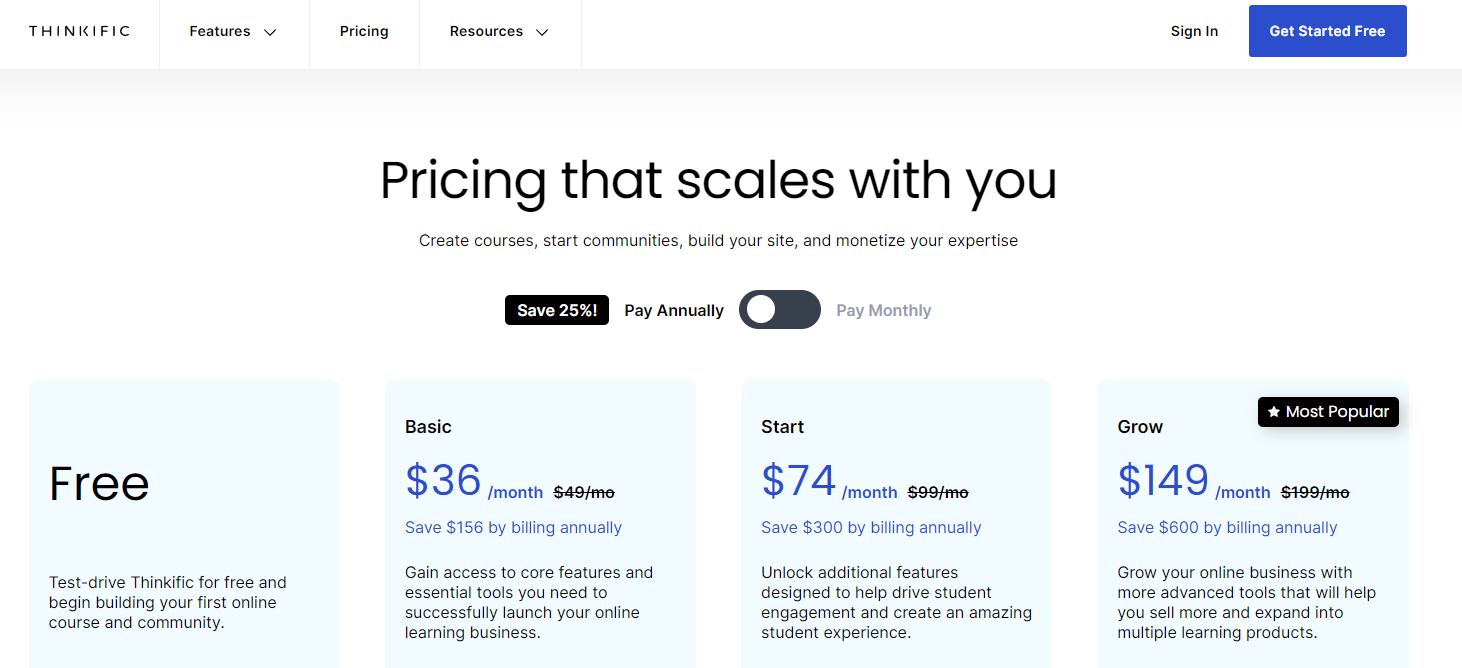
- Free plan: Gives you a taste of the platform with limited features.
- Basic plan: $36/month (annual billing) or $49/month (monthly).
- Start plan: $74/month (annual) or $99/month (monthly).
- Grow plan: $146/month (annual) or $199/month (monthly).
- Plus plan: Custom pricing designed for larger organizations.
The higher the tier, the more features you unlock.
Customer Support and Resources
If you ever run into an issue, Thinkific has several support options to get you back on track.
You’ll find a comprehensive knowledge base, video tutorials, community forums, and email support.
Live chat is available for all paid plans with the “Grow” plan, and you can also get phone and priority email support.
The abundance of self-help resources makes finding the answers you need easy.
Integration Options
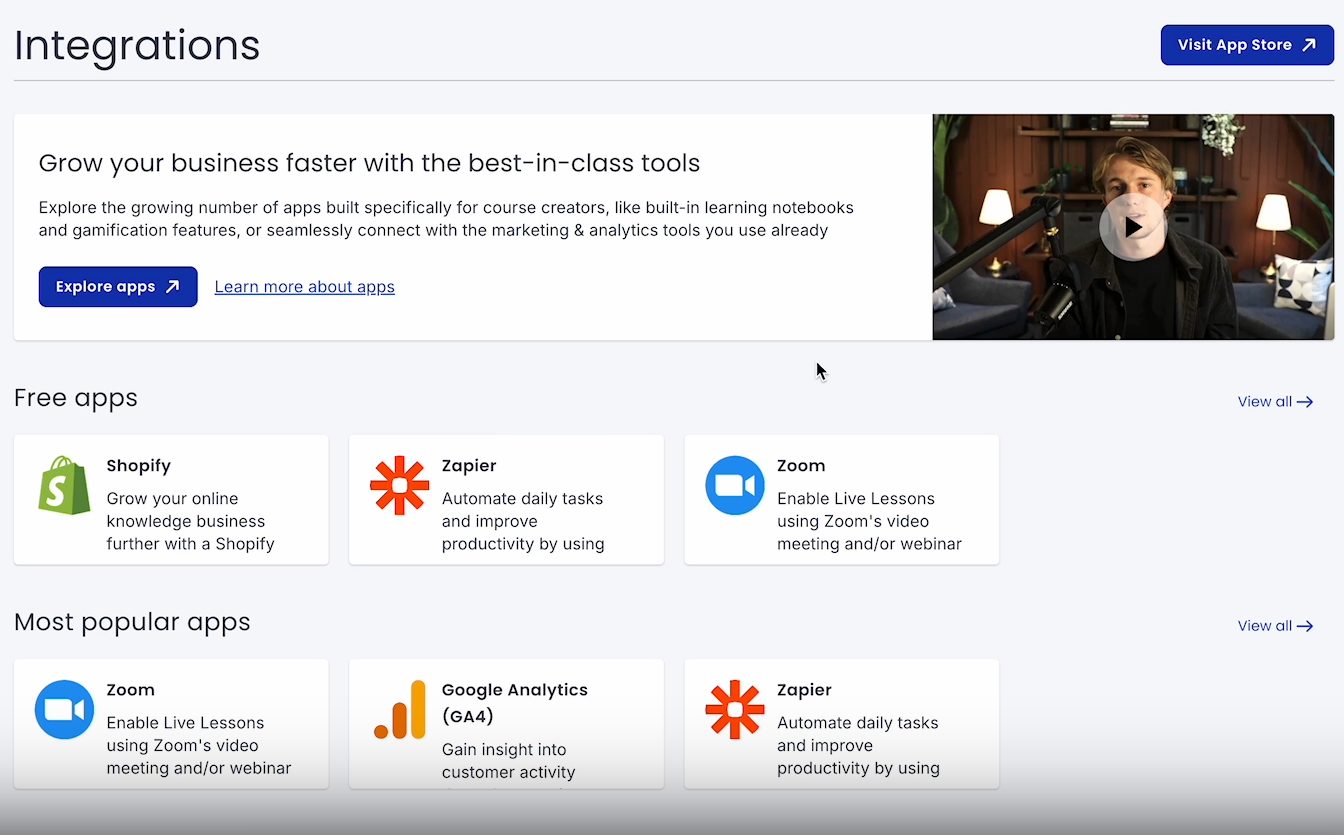
Thinkific plays well with others.
It offers integrations with popular marketing, analytics, and payment tools.
Some of the top integrations include:
- Marketing: Mailchimp, ConvertKit, ActiveCampaign
- Analytics: Google Analytics, Facebook Pixel
- Webinars: Zoom, WebinarJam
- Payment processors: Stripe, PayPal
- CRM: Salesforce, HubSpot
- Automation: Zapier
If you need more customization, there’s an API that allows you to create custom integrations.
Scalability and Performance
Thinkific is built to grow with your business.
You can create unlimited courses and enroll unlimited students on all paid plans.
Thinkific also provides bulk enrollment tools and advanced reporting features as your student base grows.
For businesses on higher-tier plans, there’s even an option to white-label the platform and have dedicated account management.
Thinkific’s infrastructure is solid and should handle high traffic without compromising performance.
What Makes Thinkific Stand Out?
There are a few unique features that give Thinkific an edge over competitors:
- AI-powered course creation assistance helps you design courses faster.
- A branded mobile app option gives you a professional edge.
- Comprehensive community-building tools boost engagement.
- Flexible content delivery options—whether self-paced, scheduled, or blended learning.
- The platform’s scalability supports businesses of all sizes, making it ideal for those planning to grow.
Pros and Cons
Like any platform, Thinkific has its strengths and weaknesses:
Pros:
- The platform is easy to use, even for beginners.
- It offers various features covering course creation, marketing, and sales.
- Community-building tools are robust, helping increase student engagement.
- There are flexible pricing options suitable for businesses at different stages of growth.
- Thinkific has a strong ecosystem of integrations, making it adaptable to your existing tools.
- Its scalable infrastructure means it can grow alongside your business.
Cons:
- Some of the more advanced features are only available on higher-tier plans.
- Mastering all of the available features can take time.
- There could be extra costs from add-ons and third-party integrations.
Where Thinkific Excels
Thinkific shines in several scenarios, including:
- First-time creators launching their first online course.
- Educators who are already established but want to scale their online presence.
- Organizations that need to implement employee training programs.
- Coaches or consultants looking to offer a mix of online and live learning experiences.
- Content creators looking to monetize their knowledge and expertise through digital products.
What Is Skool?
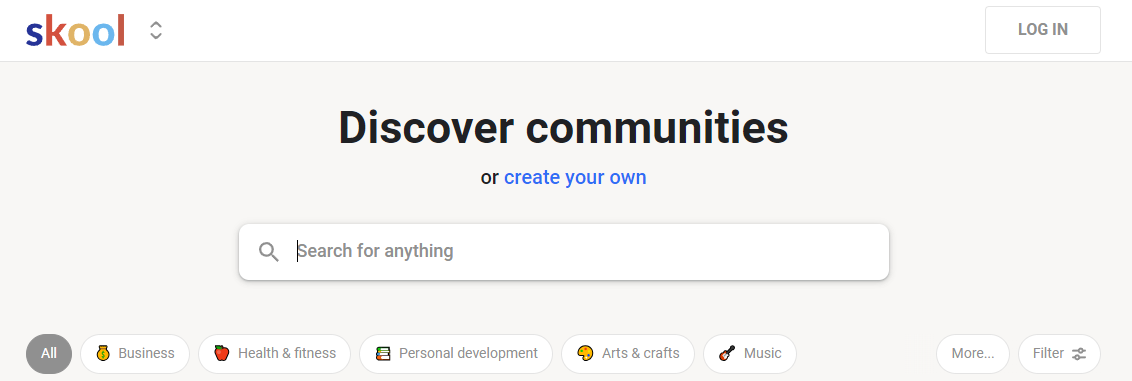
Skool is an platform designed for simplicity.
It aims to make it easy for coaches, consultants, and information entrepreneurs to build thriving online communities and host courses.
It also excels when it comes to engagement.
Its user-friendly features set it apart from platforms that try to cater to a wider audience.
At its core, Skool is built to help you streamline the process of creating and monetizing online communities.
Whether you’re a coach looking to engage clients or an entrepreneur wanting to host courses, Skool focuses on making things simple and effective.
Here’s what Skool offers:
- Community Management: Skool helps you manage a vibrant community with ease.
- Course Hosting: You can host unlimited courses within your community.
- Gamified Engagement: The platform boosts interaction with a personalized leaderboard and gamification elements.
- Mobile App: With a mobile app for iOS and Android, staying connected on the go is a breeze.
- Flexible Pricing: Skool offers options for both subscription-based and one-off courses.
Skool’s Key Areas
Here are the main things to know about this platform.
1. User Interface and Experience
Skool keeps things clean and simple.
The platform is designed with usability, offering a straightforward interface that minimizes distractions and focuses on the essentials.
Here’s what this means for you as a course creator:
- Clutter-Free Design: You won’t get bogged down by unnecessary features.
- Single Sign-On (SSO): Manage multiple groups easily without users logging in separately.
- Engagement-Boosting Tools: With features like personalized leaderboards and detailed member profiles, it encourages community interaction.
- Low Learning Curve: Both creators and members will find it easy to navigate.
Pricing and Plans
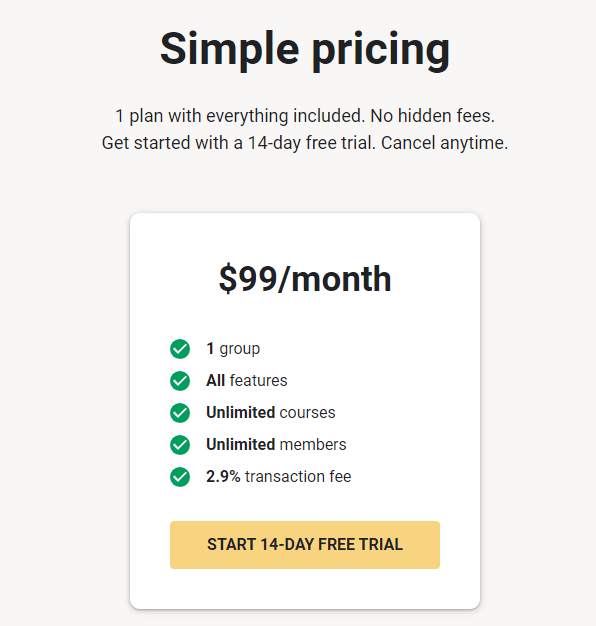
Skool keeps things simple with its pricing:
- 14-day Free Trial: Try the platform before committing.
- $99/month for One Community: This flat rate covers everything you get. There are no upsells you’ll have to purchase.
4. Customer Support and Resources
You can get support by filling in a customer support form.
When I needed help, I got responses back within a few hours.
There’s also a large community of people waiting to help within the Skool Games program.
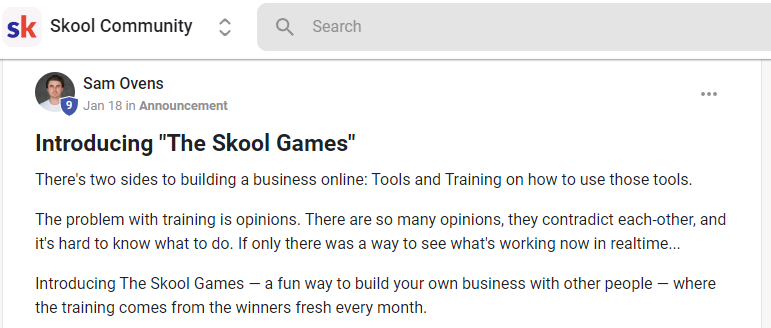
This course comes directly from those making the most money in school.
The idea is to offer you all the insights you’ll need to build and monetize your community.
This program is a great way to get your foot in the door and connect with other top creators.
5. Integration Options
Skool’s integrations are basic but useful.
You can connect with Zapier, a no-code automation tool.
This integration allows thousands of processes to be automated and linked with popular apps.
Strengths and Weaknesses
Let’s break down what Skool does well and where it falls short:
Pros:
- Simple and Clean Interface: It’s easy for creators and community members to use.
- Focus on Engagement: Features like gamified leaderboards and chat keep members active.
- Unlimited Users and Courses: You can scale as much as you need.
- Mobile App: Engage your audience from anywhere with ease.
- Skool Games Program: A fantastic resource for learning how to grow and monetize your community.
Cons:
- No Native Video Hosting Yet: You’ll have to use third-party video hosting storage to upload online videos.
- Lacks Quiz Building Abilities: No built-in quizzes, which might be a dealbreaker for some.
- No Funnel Builder: You’ll need external tools to build sales funnels.
- Limited to One Community Per Subscription: The costs will increase if you run multiple communities.
Who Should Use Skool?
Here’s where Skool works best:
- Coaches who want to create a tight-knit group around their expertise.
- Consultants offering support and education to clients.
- Information Entrepreneurs who need a platform to host membership sites.
- Educators looking for a community-driven learning experience.
- Businesses aiming to build a central hub for customer education and support.
Skool can potentially deliver a significant ROI, particularly for those prioritizing community engagement.
Here’s why:
- The community-building tools keep members engaged.
- Gamification elements encourage participation.
- With recurring revenue, your community can generate ongoing income.
- Skool’s simplicity reduces the time you spend on admin tasks.
Comparing Skool vs Thinkific
Let’s now put the two platforms head to head.
We’ve been using Skool to bring our community together, host courses, and share live events, and it’s been a straightforward process from the start.
One of the things we love about Skool is how easy it is to set up and run.
There’s no steep learning curve.
Once you’ve set up your community, it’s all about adding value without having to tinker with the platform constantly.
For us, it’s been perfect for building multiple communities.
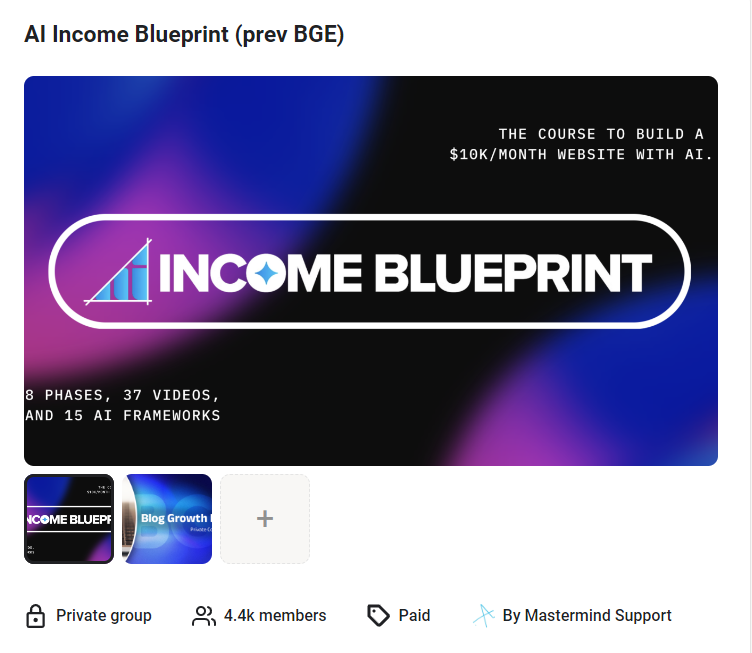
Each community has its description, member count, and even a leaderboard to see who’s most active.
This level of transparency and engagement has built community spirit.
And this would be something that requires more work on other platforms.
Could Thinkific Handle This?
Before Skool, I used Thinkific to run my online course business.
On the course creation front, things were great.
For example, Thinkific exceled at course creation.
It offered features like quizzes, certificates, and detailed progress tracking.
All of these were great for our structured learning.
For building communities?
Things were more difficult.
While Thinkific provides discussion forums, it doesn’t have Skool’s dynamic tools (and ease of access) to keep members coming back to engage.
Here, I think of leaderboards and gamification as two critical areas.
We can see who’s been contributing the most and even track engagement over the last 7 days, 30 days, or all time.
If community-building is your focus and you’re using Thinkific, you might miss out on some great stuff.
Course Creation
Skool allows us to organize our courses into modules and lessons.
This makes it easy for people to follow along and even mark lessons as complete.
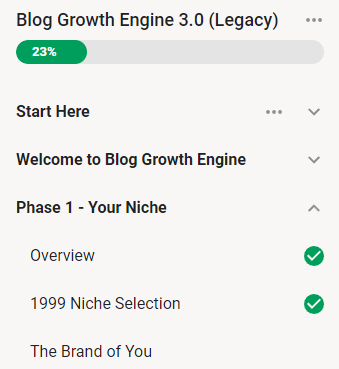
It’s a simple setup, but it works well for our members who appreciate the straightforward layout.
Thinkific, on the other hand, gives more flexibility.
You’d gain access to more tools like multimedia support and quizzes.
Overall, this could provide a better learning experience.
If your primary focus were on delivering highly interactive courses, Thinkific’s advanced features would shine.
For our business right now, Skool’s simplicity perfectly fits our needs.
Events and Live Interaction
We host frequent live events for our members, and Skool makes it easy to keep everyone in the loop.
There’s a dedicated calendar section where members can see upcoming events, add them to their personal calendars, and access all the details in one place.
The only issue?
We have to use 3rd party tools like Google Meet or Zoom.
This isn’t complex to set up, but it is something to consider.
If we moved to Thinkific, we’d still have to use third-party tools.
So it’s pretty much a tie here for both platforms.
Pricing vs. What You Get
Skool keeps it simple with a flat rate of $99 per month.
This pricing gives us one group with:
- Unlimited members
- Courses and, most importantly
- The community engagement features we rely on.
The transaction fees are also among the lowest in the industry at 2.9%.
For us, this is great value for money.
Thinkific, while flexible with pricing, has more of a tiered structure.
There are also varying transaction fee percentages.
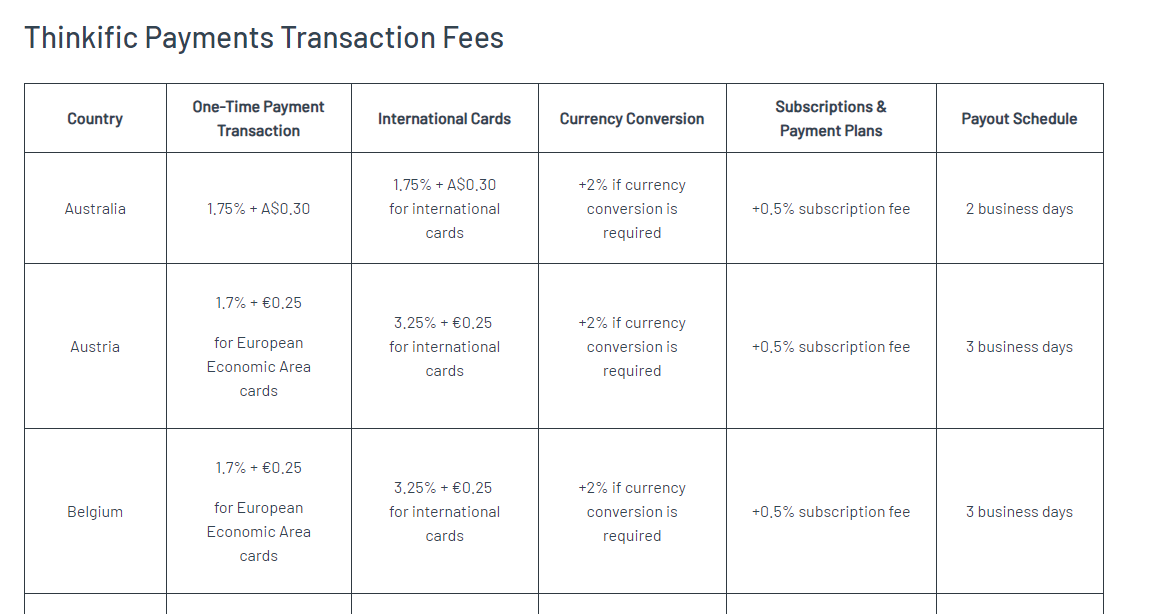
Depending on where your business is registered, this might make more or less sense for you.
In terms of pricing, if we wanted more of Thinkific’s advanced features, we’d need to upgrade to a higher-priced plan.
And that would add up as we scale.
Mobile Experience
One of the standout features of Skool is its dedicated app.
This allows our members to stay connected on the go and gives them the abilities to switch between communities and access course content.
This can be a distraction when members are part of multiple groups.
At the same time, it’s a great way to keep engagement high when people are away from their desks.
On the Thinkific side, there is a brandable mobile app.
This means you can customize the app to fit your brand – and your brand only.
This feature can give your business a professional, seamless mobile experience for your learners, letting them access courses anytime, anywhere.
If having a branded mobile presence is important to you, this could be a big advantage.
So, if your priority is branding and you want full control over the look and feel of your app, Thinkific’s brandable app might be the better fit.
However, if fostering community engagement is more critical, Skool’s app remains a strong contender.
Conclusion
Skool has become the right fit for our business because it emphasizes community and engagement.
The leaderboard, the chat features, and the ease of running multiple communities make Skool feel like home for us and our members.
If we switched back to Thinkific, we’d gain some advanced course creation tools and customization options.
We’d also probably lose the sense of community that Skool fosters.
Ultimately, the decision comes down to what you prioritize.
If you’re looking for a simple, streamlined, and community-focused platform, Skool might be the perfect choice.
But if your main focus is building more complex courses with all the bells and whistles, go with Thinkific.
Their advanced features are worth exploring.
Further reading on AdamEnfroy.com: If you’re looking for more insights on platforms like Skool and Thinkific, you might want to explore the best community platforms to find the right fit for your audience.
You can also dive into the top membership site platforms to see how they stack up.
Check out my guide on the best online learning platforms if online learning is your focus.
For more advanced insights, my learning management Systems guide might be just what you need to structure your course for success.
-

7 BEST Blog Hosting Sites in 2024 (Ranked By 7-Figure Blogger)
You know what kills a blog fast (faster than bad content)?
Bad, slow, unreliable blog hosting.
The truth is that your blog’s success depends a lot on the hosting you pick.
Get it right, and your blog will be fast, smooth, and ready to handle more readers.
Get it wrong and your content efforts will be all for nothing.
That’s why in this guide, I’ll show you the best blog hosting providers to consider.
These hosting options will keep your blog running smoothly – no matter how many visitors you have.
What Is the Best Web Hosting for Blogging?
Here are the top blog hosting providers to consider.
1. Bluehost
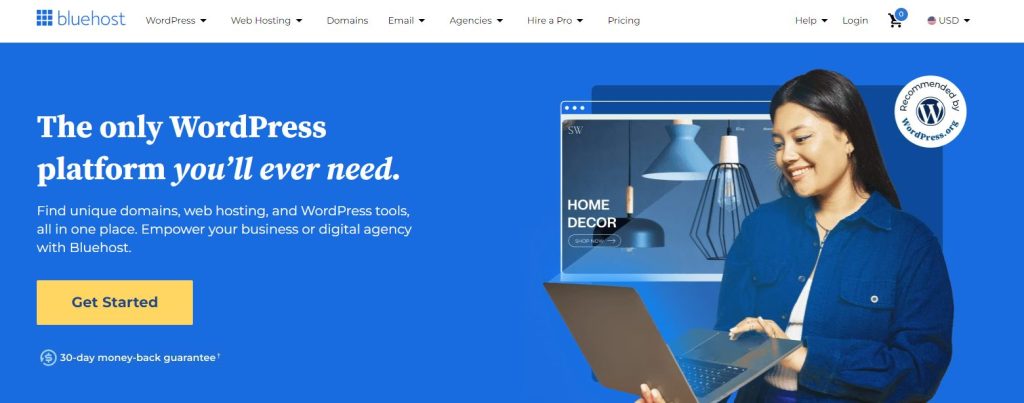
Bluehost has been in the game since 2003.
Millions of websites are powered by its platform, making it one of the most trusted names in web hosting.
What really makes Bluehost stand out is its seamless integration with WordPress.
In fact, WordPress.org officially recommends Bluehost as one of its top hosting providers.
That’s not something they do lightly!
This endorsement speaks volumes about Bluehost’s ability to create a WordPress-friendly environment where your blog can thrive.
Key Features
Bluehost doesn’t just give you a place to host your blog.
It gives you a complete toolkit to make things easy and affordable.
For instance, you get a free domain name for the first year when you sign up.
That’s a great little bonus that saves cash and simplifies the setup process.
Plans start as low as $2.95 per month which is great even for those on a budget.
The best part about Bluehost?
Their user-friendly control panel.
Unlike other hosts that rely on the standard (and often clunky) cPanel, Bluehost has created a custom panel that’s clean and easy to navigate.
From here, you can manage your domain, emails, databases, and more.
Need a hands-on approach?
Bluehost also offers a drag-and-drop website builder.
This allows you to build a beautiful, professional-looking blog without needing to touch a line of code.
Tech Integrations
Bluehost is designed to make the technical side of running a blog as simple as possible:
- One-Click WordPress Install: You can have your blog live in just minutes. Plus, Bluehost automatically updates WordPress for you, so your site is always running on the most secure, up-to-date version.
- Fast Load Times: Bluehost’s partnership with Cloudflare brings a free CDN (Content Delivery Network) to the table. This means faster load times, no matter where your visitors are located.
- Top-Notch Security: Bluehost provides free SSL certificates through Let’s Encrypt. Not only does this protect your visitors’ data, but it also gives your blog a boost in search engine rankings since Google prioritizes secure sites.
For the more tech-savvy bloggers, Bluehost offers some advanced options too:
- SSH Access: For secure server connections and advanced customizations.
- PHP Compatibility: Support for the latest PHP versions, plus easy switching between versions.
- Git Integration: For those who want to manage and deploy code changes more efficiently, Bluehost has integrated Git version control into its offering.
Verdict
For most people, the answer is yes.
If you’re a beginner, the easy setup, intuitive control panel, and strong customer support make it an ideal starting point.
And if you’re a more experienced blogger or developer, you’ll love the SSH access, Git integration, and other advanced features.
2. Hostinger
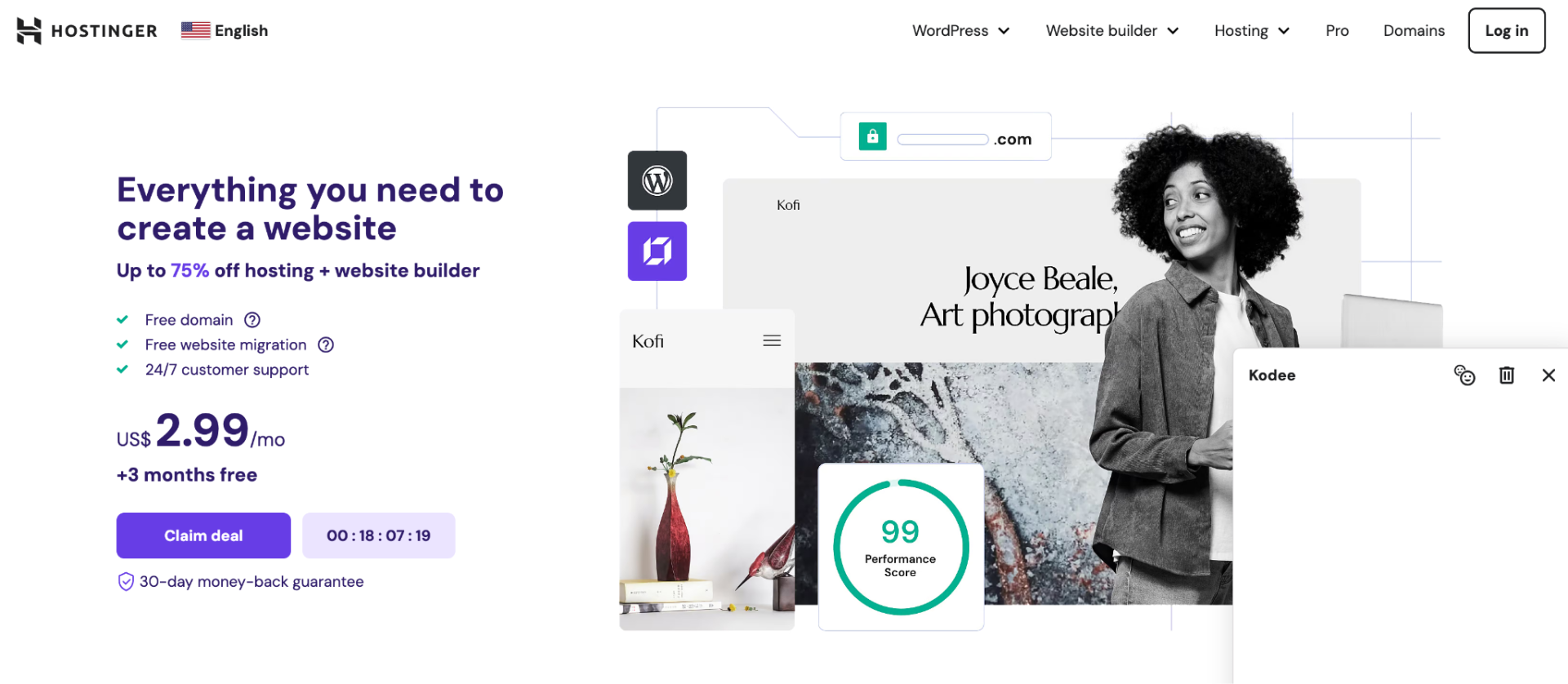
Hostinger is another great blog hosting service to consider.
It’s built a reputation for offering a rare combo: affordable pricing and great performance.
If you’re starting your blogging journey or you’ve been around and want to switch things up, Hostinger’s features are worth your attention.
Key Features
First off, let’s talk speed.
Hostinger uses something called LiteSpeed web servers.
This is like having a blog loaded on caffeine—it loads fast.
That’s huge because faster sites make visitors happy and help you rank better in search engines.
It’s a win-win.
But speed isn’t the only thing going for Hostinger.
They also offer a one-click WordPress installation.
This means you click a button, and that’s all you have to do tech-wise.
Fast, easy, no-hassle WordPress setup.
For new bloggers, it’s a huge time-saver.
Here’s another point in favor of Hosting: freebies.
Who doesn’t love a good deal?
Hostinger gives you a free domain name if you sign up for an annual plan.
And for those who love to tweak and customize, they’ve got a staging environment.
Think of it like a playground where you can test changes to your blog – without actually making those changes live.
You can mess around with different looks or plugins to see how they work.
Then, you can easily revert if you don’t like what you see.
Tech Integrations
Pretty awesome, right?
Hostinger has some great tech that makes a blogger’s life smoother.
Their custom control panel, hPanel, is designed for simplicity—even if you aren’t a techie.
And for the WordPress crowd (i.e., most bloggers), Hostinger offers WordPress acceleration.
What does that mean?
It’s all about making your site load faster and ensuring visitors aren’t left staring at a blank screen.
Plus, they’ve started integrating some AI tools into the mix.
And then there’s security.
Hostinger ensures your site is protected with free SSL certificates, automatic backups, and a dedicated security team.
Verdict
If you want affordable hosting that doesn’t compromise on quality, Hostinger is worth considering.
It’s especially appealing if you’re new to blogging or running a small to medium-sized blog.
The speed is impressive, the tools are easy to use, and the WordPress-specific features are a real plus for us bloggers.
Of course, no hosting service is perfect.
Some users mention that as your blog grows, you might need to upgrade from their entry-level plans to something more robust.
And if you’re planning to run a high-traffic blog with tons of visitors, you might want to check out their bigger plans.
3. WPX
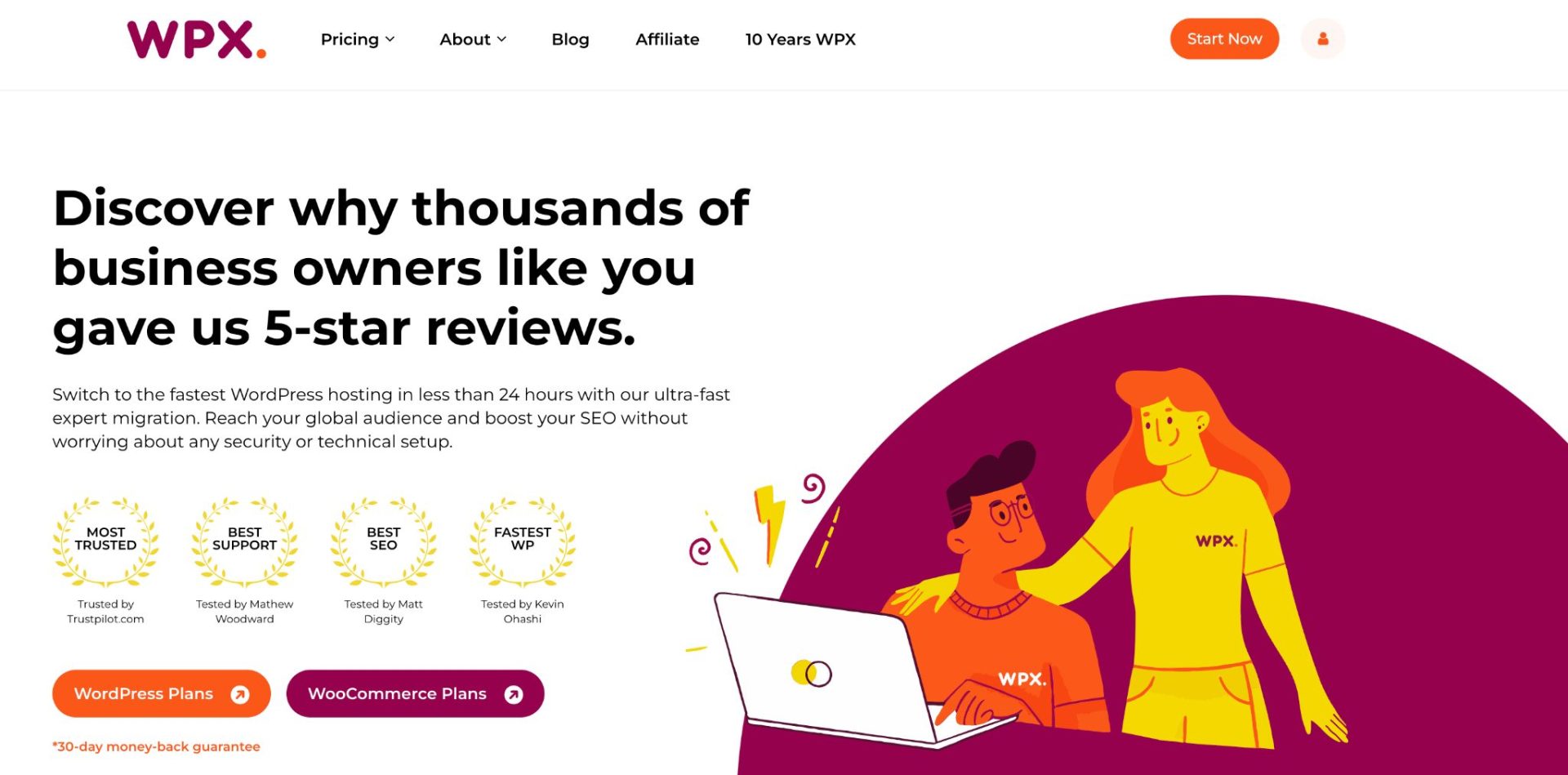
WPX Hosting is one of those names that keeps popping up when discussing blog hosting.
WPX’s mission is specifically aimed at bloggers and small businesses who want their websites to be fast, reliable, and stress-free.
The platform was founded in 2013 to try to take on the big hosting guys.
Fast forward a few years, and it’s now one of the go-to options for WordPress users.
Why?
WPX focuses on three simple promises: speed, support, and simplicity.
They’re not here to complicate things.
Instead, they want to make hosting easier and faster for you.
And as a blogger, that’s a huge deal.
The less time you spend worrying about your website, the more time you can spend, you know, actually blogging.
Key Features
Okay, so what are you really getting with WPX?
First off, their custom-built CDN, called XDN, is a big deal.
It’s got 37 points scattered all over the globe.
Wherever your readers are, they’re going to get a fast-loading experience.
And this is included in all their plans.
No extra fees, no surprises.
That’s a big win for those who hate add-ons (and slow blogs and websites).
Now, if you’ve ever tried contacting tech support, you know it can be… a journey.
WPX promises something better: live chat responses within 30 seconds.
Not only that, but they take the “hands-on” approach.
Instead of giving you a complicated list of steps to fix an issue, they often just fix it for you.
Imagine that – actual help, without the hassle.
And it’s not just empty promises.
I’ve seen firsthand that this works.
Another favorite feature is the free site speed optimization.
Their team looks at your site and tweaks things to help it run faster.
Normally, this kind of service costs extra or requires hiring outside help.
Here, it’s all included.
And if you’re worried about security (who isn’t?), WPX has you covered with daily malware scans and cleanup.
They proactively scan your site and remove anything that looks shady.
Again, they do this without you lifting a finger—or having to take out your wallet.
Tech Integrations
Now, let’s geek out a bit (just for a moment, I promise).
WPX uses an LLMP stack—which stands for Linux, LiteSpeed Web Server, MariaDB, and PHP.
It’s a cousin to the classic LAMP stack but with some enhancements that make it faster.
Translation?
It’s optimized to keep your blog humming along nicely.
They’re always on the latest versions of PHP, which is a big deal for keeping things secure and speedy.
Plus, they use SSD storage, which is much quicker than old-school hard drives.
But here’s something to consider: WPX is really designed for WordPress.
Sure, you could technically host other types of sites.
But that’s not what they’re here for.
If you’re a WordPress user, WPX has all the bells and whistles to make your life easier.
If you’re not, you might be better off elsewhere.
Verdict
If you’re a WordPress blogger or small business owner, WPX offers some serious perks.
They offer speed, proactive support, a powerful CDN, and security.
And it’s all included without upselling you every five minutes.
That said, they’re not the cheapest option out there.
You’re paying for top-notch service and extra perks.
If your budget is really tight, WPX might feel a bit pricey.
But if you’re serious about growing your blog or online business (and you want a reliable hosting provider that genuinely cares about performance) WPX is a solid contender.
In a nutshell, WPX hits that sweet spot for those who want a balance of:
- Speed
- Support
- And ease
…without dealing with the nitty-gritty themselves.
If that’s the relationship you want with your hosting provider, WPX could be exactly what you need.
4. DreamHost
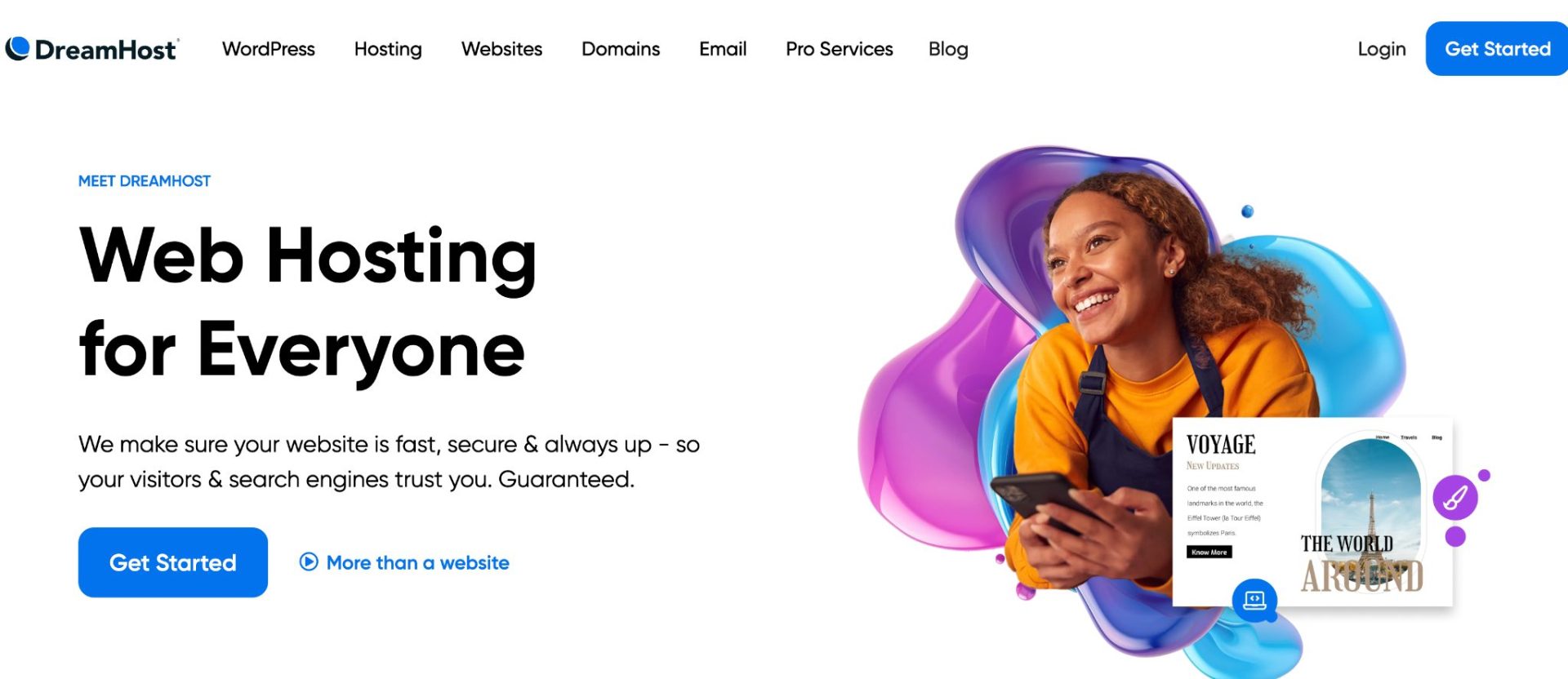
DreamHost is another low-cost option for starting and hosting your blog.
It also has some standout features that make it popular among bloggers.
My favorite?
Their 100% uptime guarantee.
Let’s break down exactly what makes DreamHost tick.
Key Features That Make DreamHost Shine
Here is all you need to know about DreamHost.
1. One-Click WordPress Installation
Starting a blog can be overwhelming, especially if you’re not a tech wizard.
DreamHost’s one-click WordPress installation feature means you don’t need to mess with complicated setups or confusing instructions.
Just click, and you’re good to go—it is that simple.
2. 100% Uptime Guarantee
Here’s something that sets DreamHost apart: their 100% uptime guarantee.
In the world of web hosting, this is a bold promise.
It means your blog should always be accessible, no matter what.
This is crucial if you’re serious about your readers always being able to reach your content, day or night.
3. Free Domain Name & SSL Certificate
DreamHost throws in a free domain name if you sign up for an annual plan.
It’s one less thing to worry about when you’re just getting started.
Plus, they include a free SSL certificate.
Why does that matter?
This certificate keeps your blog secure and helps your search engine rankings—a win-win.
4. Green Hosting
If you’re environmentally conscious, here’s a nice touch.
DreamHost powers its data centers with renewable energy.
It’s great to know the way your blog is hosted is kind to the planet.
Tech Integrations
DreamHost uses solid-state drives (SSDs) for all storage.
What’s the big deal about SSDs?
In short, they make your blog load faster, and faster load times mean happier readers and better SEO.
DreamHost also plays well with WordPress.
They’ve got servers optimized specifically for WordPress.
This optimization makes everything run smoother.
Then there’s DreamPress.
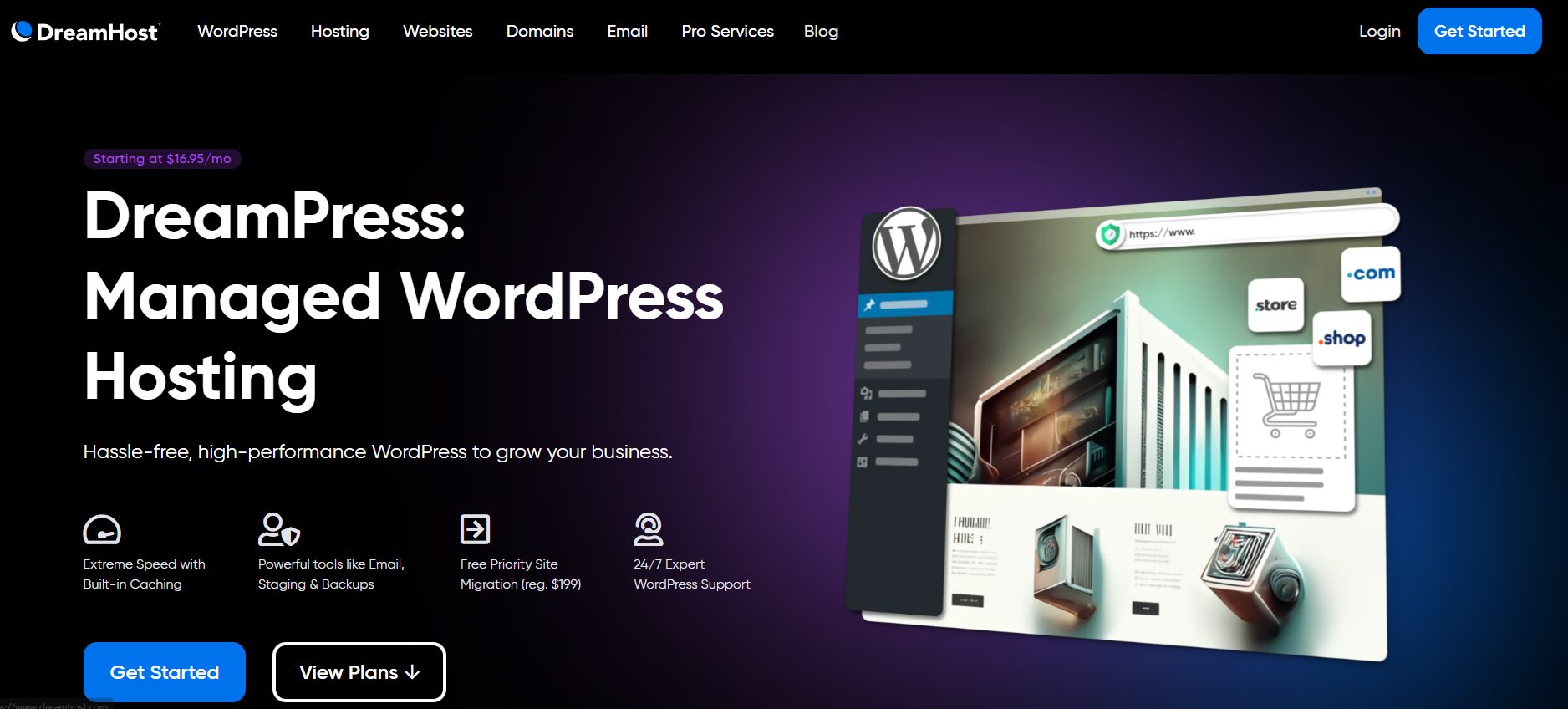
DreamPress is DreamHost’s managed WordPress hosting.
This is ideal for those who don’t want to sweat the technical stuff.
It’s more expensive than their basic hosting plans, but you get some nice extras like automatic updates and backups.
It’s perfect if you’d rather focus on writing than managing your server.
DreamHost also doesn’t use the typical cPanel like many other hosts.
Instead, they have their custom control panel.
Some people love it, while others need time to get used to it.
But it’s designed to be beginner-friendly, which is a plus if you’re not super tech-savvy.
Verdict
DreamHost is a solid option for bloggers.
Their WordPress-friendly features, reliable uptime, and ease of setup make them a great choice.
With DreamHost, you’re buying reliability, speed, and some handy features.
If you’re just starting and want a host that makes getting your blog up and running as easy as possible, DreamHost is worth a close look.
And if you’re an experienced blogger needing a host that can handle your growing audience, their scalable plans have you covered.
5. FastComet
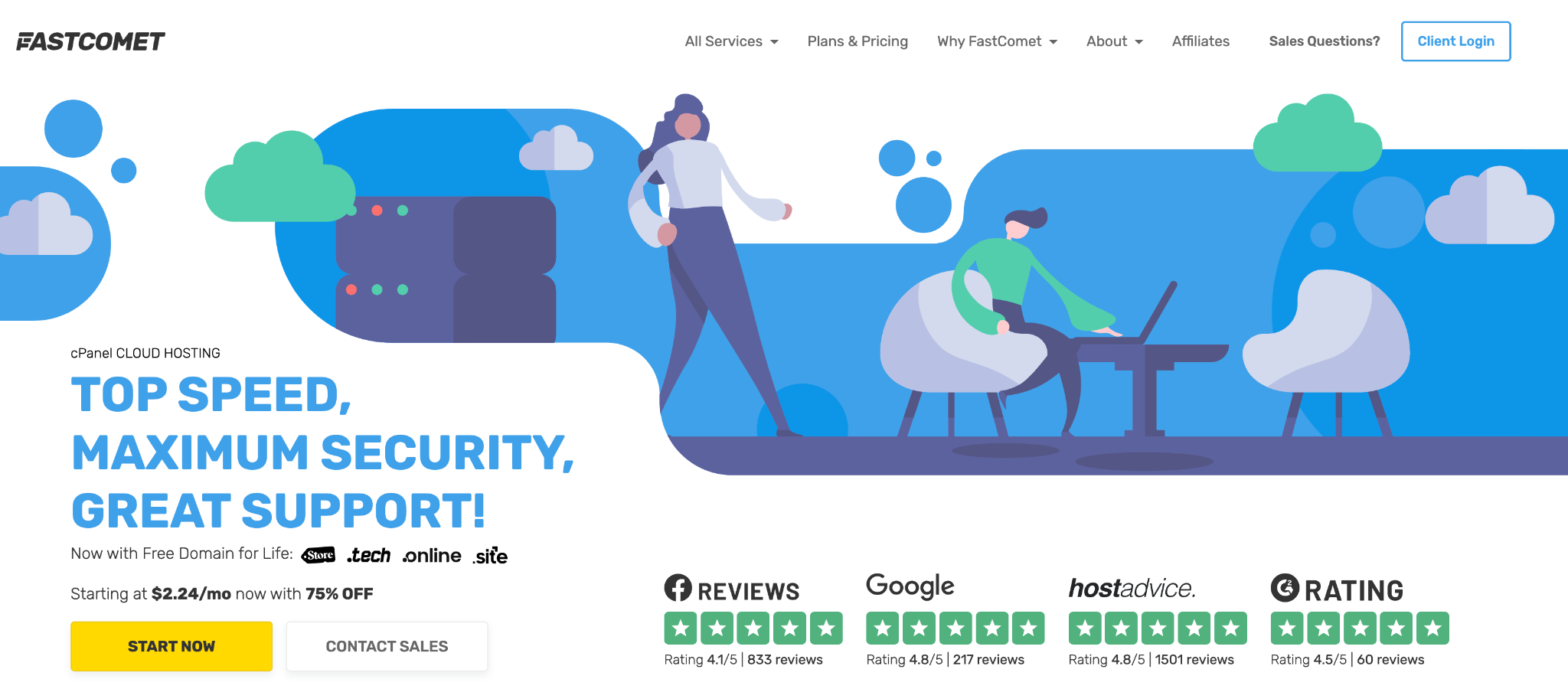
FastComet has been making waves in the blogging and small business owner community.
Their current standout feature?
They offer a free domain for life.
Yes, you heard that right – for life!
If you’re just starting out and trying to keep costs low, that’s a pretty sweet deal.
But saving money is only the beginning.
Here’s what FastComet is all about.
Key Features
FastComet takes speed very seriously.
They use something called LiteSpeed Web Server.
The idea is that your website loads super fast.
And if you’re running a WordPress blog (like so many of us are), this is fantastic news.
A fast-loading site keeps visitors happy and can even boost your search engine rankings.
Security?
Yep, they’ve got you covered there, too.
FastComet includes Imunify360 with all their plans.
This service keeps hackers away so you can focus on creating awesome content without the constant worry.
And here’s a big plus: their customer support.
They promise a 15-minute response time.
This level of service is great when things don’t go as planned.
Tech and Integration
FastComet is not just about flashy servers and fancy security.
They’ve also made everything easy for bloggers and website owners.
For instance, they offer a one-click WordPress installation.
If you’ve ever tried manually setting up WordPress, you’ll appreciate how much of a lifesaver this is.
All it takes is one click, and your site is live.
They also use NVMe SSD storage.
Not to get too geeky, but this means your data is stored on super-fast drives.
Your blog posts, images, and everything else load incredibly fast for your readers.
Another impressive feature?
Their integration with Cloudflare CDN.
What does that mean for you?
Well, it means your content gets delivered quickly to visitors worldwide – whether in New York or New Delhi, they’ll get a smooth, speedy experience.
Verdict
If you’re looking for a hosting provider that balances great features, speed, and customer support, FastComet is worth considering.
You get fast servers, strong security, and helpful support.
For most bloggers and small to medium-sized sites, FastComet delivers a compelling package.
6. SiteGround
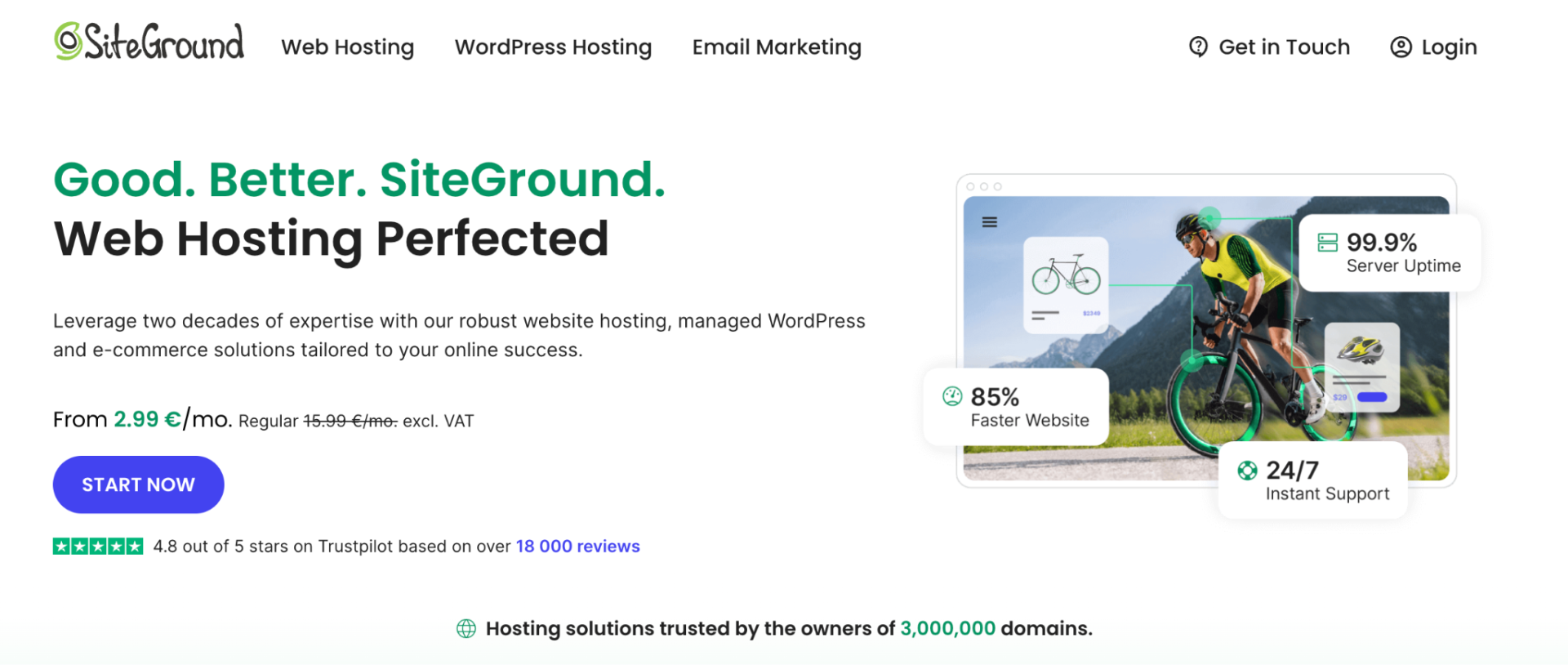
SiteGround is a very future-looking blog hosting company.
It merges powerful AI features with simplicity ready for beginners and pros alike.
Then, it brings everything together without making you feel like you’re in over your head.
Key Features
Here’s all you need to know about SiteGround:
- Core Features for All Bloggers:
- WordPress-optimized hosting: SiteGround is one of the best for running a WordPress site smoothly, giving you faster loading times and a smoother setup.
- Free SSL Certificates: Security is crucial, and SiteGround provides free SSL for all sites, meaning your visitors’ data stays protected.
- Daily Backups: Rest easy knowing that SiteGround takes daily snapshots of your website so you can restore your content if anything goes wrong.
- Unmetered Traffic: No worries about hitting traffic limits; SiteGround can handle the volume, letting your blog grow without restrictions.
- Unique Yet Standard Offerings:
- SG Optimizer Plugin: SiteGround’s own plugin keeps your site fast by continuously optimizing performance.
- Staging Environment: Want to test changes without making them live right away?
SiteGround’s staging lets you do that easily- turn it on when needed. - Collaborator Management: This feature makes working with a team a breeze, whether it’s editors or developers.
- Next-Level Features:
- AI-Powered Tools: SiteGround uses AI to help enhance your content, suggesting improvements that can save you time and boost quality.
- Free Cloudflare CDN: For faster, global content delivery, SiteGround integrates with Cloudflare, meaning your blog’s speed won’t lag regardless of where your audience is.
Technology and Integration
Speed is the name of the game, and SiteGround takes this to heart.
Using Google Cloud infrastructure, SiteGround ensures lightning-fast delivery times.
They’ve also developed SuperCacher technology.
This feature caches your website content so (it feels like) your pages are served quicker than ever.
SiteGround also uses AI-driven firewalls that adapt and learn.
These firewalls protect your site from the moment a threat emerges.
The system is proactive, which means less downtime and fewer worries about attacks.
SiteGround’s support team is available 24/7.
And when requested, the team doesn’t just respond fast—they give you exactly what you need.
No matter the complexity of your issue, they’re always ready to guide you.
This is a refreshing change if you’ve ever struggled with hosting support.
And when your business starts growing?
SiteGround scales right alongside you.
They offer plans like StartUp, GrowBig, and GoGeek.
Each plan is tailored for different stages of growth.
Switching plans as your needs change is easy with no awkward growing pains.
If you care about the environment, you’ll also be glad to know that SiteGround is fully powered by renewable energy.
It’s not just about being fast and secure.
They’re also helping to reduce your blog’s carbon footprint.
Verdict
SiteGround is designed to grow with you.
It adapts to your needs and helps your blog reach audiences far and wide.
Overall, SiteGround provides the tools to make your blogging experience seamless, powerful, and ready for what comes next.
7. Lyrical Host
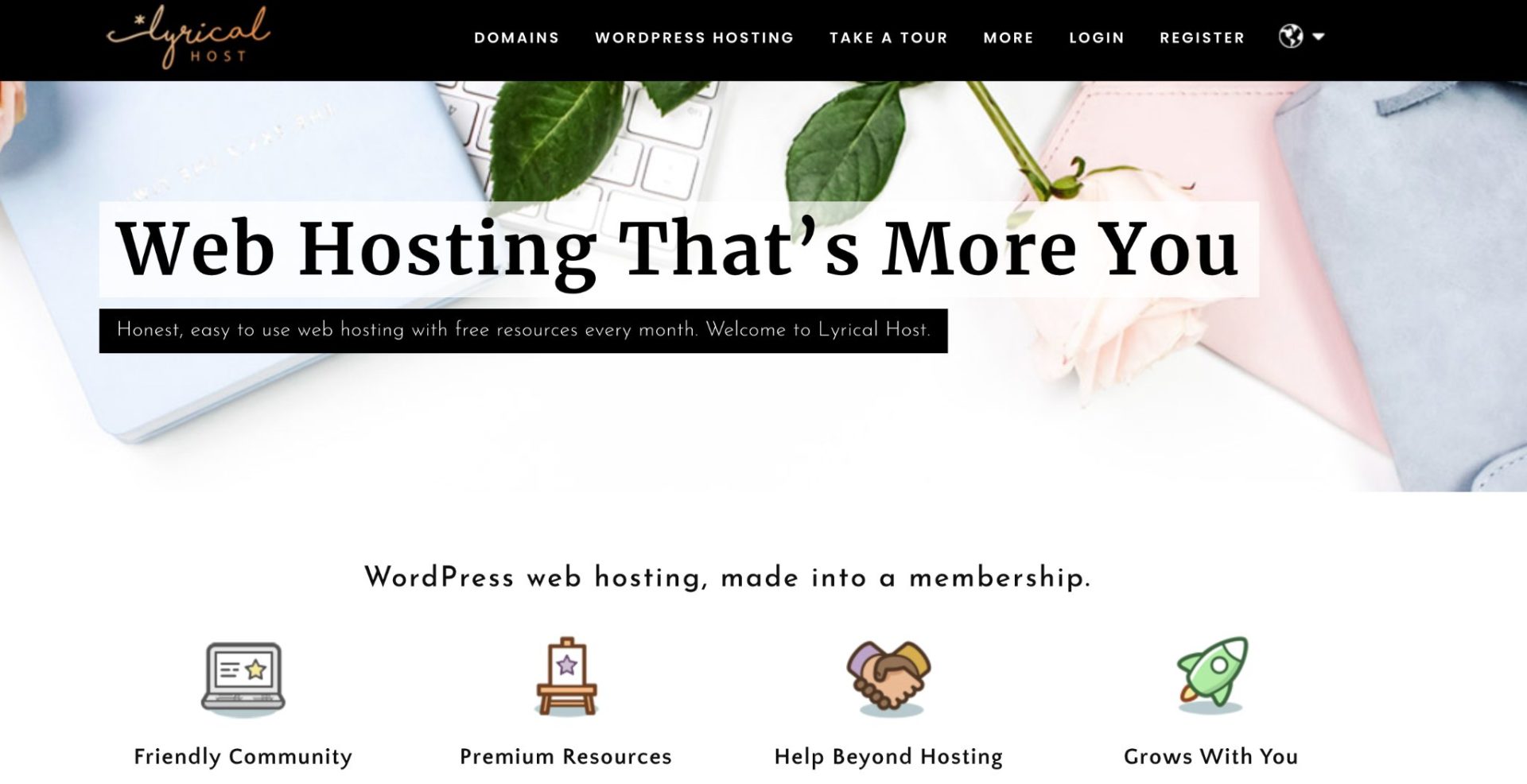
It seems like every other day there’s a new blog hosting platform popping up.
And for some, it might seem like Lyrical Host fits the bill.
However, this platform has managed to grab (the right type of) attention.
Why?
It’s all about how the people behind the hosting blend solid tech with creativity and personal touch.
Think of Lyrical Host not just as server space but as a cozy, welcoming home for your website.
It’s also complete with those little extras you didn’t even know you wanted.
Key Features
Like many other blog hosting platforms, speed is key.
For this, they use high-quality SSDs to power their servers.
In simple terms, your site loads fast (like blink-and-it’s-there fast).
Plus, they’ve got some pretty slick caching features that make WordPress sites extra smooth.
But it’s not all tech talk.
Lyrical Host sends their customers exclusive stock photos and digital resources each month.
It’s almost like receiving a little surprise care package for your site every month.
These small, thoughtful touches make the hosting experience a bit more fun.
And let’s talk about support.
Whether you need help with a WordPress issue or want to make your site look snazzier, you have people to turn to.
Their team is there, ready to help you with enthusiasm and great ideas.
Technology and Integration
Now, let’s geek out a little.
Lyrical Host has thought of every tiny detail to get WordPress running at its best.
They’ve got an auto-scaling setup, which is pretty impressive.
What does that mean for you?
If your latest blog post suddenly goes viral (here’s hoping!), you don’t have to worry about your site crashing under the weight of all those new visitors.
It scales up automatically, keeping your site cruising along effortlessly.
And regarding security, they take daily backups, offer malware scans, and even give free SSL certificates.
This covers all you need to think about when it comes to keeping your site protected.
Verdict
Lyrical Host is worth a peek if you’re a blogger looking for more than a bare-bones hosting setup.
They’ve hit a sweet spot between dependable technology and creative, personal support.
This combo speaks to the needs of content creators and small business owners.
They’re not the biggest name in hosting.
However, the smaller players sometimes offer that personal touch that makes all the difference.
Conclusion
Choosing the right blog hosting makes a big difference.
The right host keeps your site fast, secure, and ready to grow.
Remember, good hosting isn’t just about price.